Introduction to Aerospace
Introduction
Aerospace engineering encompasses the design, construction, testing, and evaluation of aerial systems that operate beyond Earth’s surface. The field integrates multiple engineering disciplines including aerodynamics, avionics, materials science, and propulsion to address the complexities of flight and control. Aerospace engineers play a crucial role in advancing technology for aviation, defense, space exploration, and research.
Objectives
- Understand the fundamental principles of aerodynamics and their application in designing efficient aircraft and spacecraft.
- Explore the role of avionics in modern aerospace systems, including navigation, communication, and control technologies.
- Examine materials science as it relates to selecting and utilizing materials that enhance the performance, safety, and sustainability of aerospace vehicles.
4 Main Principles of Aerospace
Aerodynamics
Definition: The study of how motion through a fluid affects both the vehicle and the fluid.
Key Concepts:
- Examines the effect of air flowing over objects and the production of forces such as lift and drag.
- Important for understanding power and energy consumption related to friction and drag.
Engineers use computational fluid dynamics (CFD) and wind tunnel testing to optimize the shape and performance of aircraft and spacecraft, minimizing drag and maximizing lift.
Avionics
Definition: The study of electrical and mechanical instrumentation used in aircraft and spacecraft.
Key Concepts:
- Involves systems for communication, navigation, engines, and aircraft movement.
- Combines engineering principles with human factors, focusing on safety and efficiency in flight operations.
Modern avionics systems rely on advanced software, sensors, and automation to enhance performance and safety in increasingly complex aerospace environments.
Material Science
Definition: The study of characteristics and properties of materials used in aerospace applications.
Key Concepts:
- Focuses on designing crafts that are strong yet light, rigid but flexible, and durable but repairable.
- Evolved from traditional materials like wood and metal to advanced composites and alloys.
E.g. Aluminum alloys incorporating copper, magnesium and zinc; carbon fiber
Propulsion
Definition: The systems or engines that convert energy into mechanical force for movement.
Key Concepts:
- Involves the generation of thrust to overcome drag and stabilize craft.
- Explores energy extraction from fuels to create propulsion forces for various flight profiles.
Engineers work to improve propulsion efficiency, reduce emissions, and develop new technologies for supersonic and hypersonic flight, as well as for deep-space exploration.
Additional Resources
For Readers

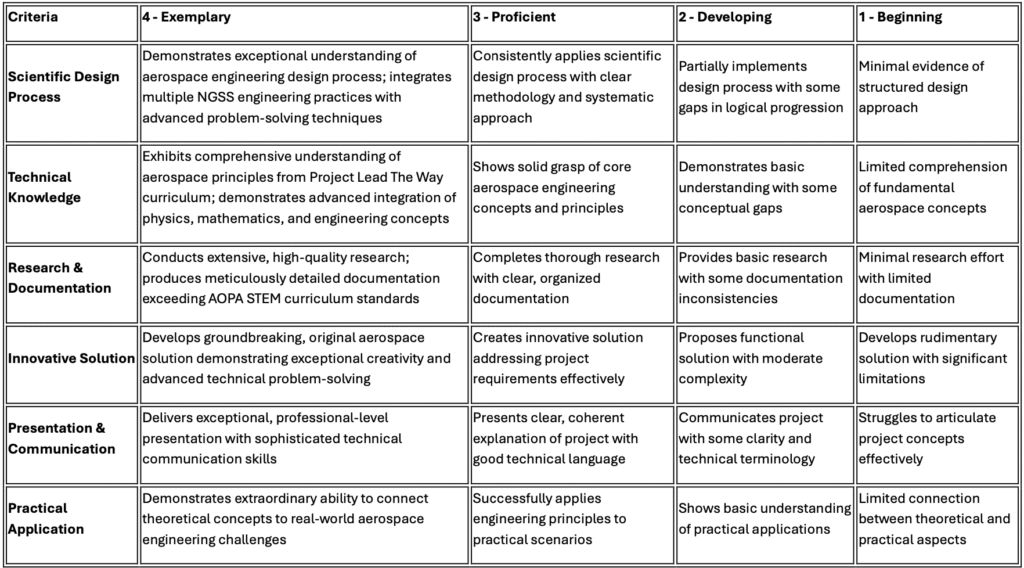
Assignment
Assignment Overview
A presentation/poster answering the question “How does aerospace technology influence our daily lives, and what innovations can shape the future of
air travel?”