Unpowered Flight
Introduction
How does an unpowered glider gain forward motion? When you fly a paper airplane, you throw it in a forward motion in order to fly in the forward direction. But a powered airplane is too heavy to throw, and throwing an airplane does not provide a constant forward force. So how did people solve this problem? Through different kinds of engines and propellers, a full-sized airplane can travel forward consistently and through long distances.
Objectives
- Understand the fundamental forces and aerodynamic principles—such as lift, drag, and thrust—that make unpowered, sustained flight possible.
- Explore the historical development and evolution of unpowered flight technologies, including different types of aircraft like gliders and their specific uses.
- Analyze real-world applications of unpowered flight in fields like scientific research, environmental monitoring, and recreational aviation.
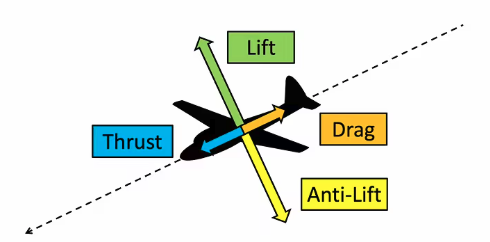
4 Forces of Flight
Lift
Definition: The upward force that opposes weight and supports an aircraft in the air.
Key Concepts
- Generated by air flowing over a wing, creating lower pressure on top and higher pressure underneath
- Lift must be greater than or equal to weight for sustained flight
- Wing shape (airfoil), angle of attack, and airspeed all affect lift production
Weight
Definition: The downward force caused by gravity acting on the mass of the aircraft.
Key Concepts:
- Pulls the aircraft toward the Earth’s center
- Determined by the aircraft’s mass and gravitational pull
- Must be counteracted by lift for takeoff and sustained flight
Thrust
Definition: The forward-moving force that propels an aircraft through the air.
Key Concepts:
- Produced by engines (in powered flight) or by converting potential energy into forward motion (in gliders)
- Must overcome drag for acceleration and forward movement
- No thrust exists in unpowered flight—motion is sustained through descent and lift
Drag
Definition: The air resistance that opposes an aircraft’s forward motion.
Key Concepts:
- Acts opposite to the direction of thrust or motion
- Caused by friction with air (aerodynamic drag) and turbulence
- Reducing drag improves fuel efficiency and flight range
Additional Concepts
Glide Ratio
Definition: The glide ratio is the ratio of horizontal distance traveled to vertical descent.
Key Concepts:
- It’s numerically equal to the Lift-to-Drag ratio
- A glide ratio of 40:1 means the aircraft moves 40 units forward for every 1 unit it drops
- It measures aerodynamic efficiency and helps compare designs like wing shapes or gliders
Engineers use computational fluid dynamics (CFD) and wind tunnel testing to optimize the shape and performance of aircraft and spacecraft, minimizing drag and maximizing lift.
Torque & Stability
Definition: Torque is a rotational force that affects how an aircraft maintains balance and control.
Key Concepts:
- Torque impacts pitch, roll, and yaw—key to flight control
- Stability is crucial in unpowered flight, where small shifts in balance or wind can greatly affect performance
- Aircraft design minimizes unintended torque for smoother, safer gliding
Principles of Aerodynamics in Unpowered Flight
Key Concepts:
- Cambered wings (curved surfaces) create pressure differences that generate lift
- Gliders use thermals (rising warm air) to gain altitude
- Balloons rise due to buoyancy—hot air or helium is less dense than surrounding air
Additional Resources
For Readers
Assignment
Assignment Overview
Balsa Wood Glider Lab